Not with that technique: no gloves, safety glasses, fume hood; the volume in the erlenmeyer flask is not suitable for what the flask allows; and the fumes from the left vessel are dangerously close to her nasal orifice. The only D she is asking for is Disaster.
Did they ever reveal how Captain America was thawed? Because I’m picturing a bunch of Shield agents with hair dryers and I don’t think that’s quite right.
I don’t think they’d want to microwave him so hair dryer is really the only remaining option. That’s how I’d do it.
Do you have a sciency way to accomplish this task?
Well, let’s see.
To thaw a 1.5 metric ton colossal squid frozen in a block of ice (the only way the fishermen who trawled the thing in could bring it home before it went bad), scientists put it in a big vat of brine just above 0 Celsius/32F. That allowed the fresh water to melt while still keeping the squid as cold as possible. Essential, since for a giant corpse with tentacles, certain parts are bound to thaw days before others and could become quite rotten before the rest comes out of the ice block if you’re not careful.
HOWEVER Captain America was still alive, which complicates things. On the other hand, even supersoldiers are significantly smaller than this record-setting colossal squid. This helps thaw logistics somewhat.
Much like the squid, Captain America would have to be kept at a consistent temperature throughout his body in order to be thawed successfully. If his extremities were to thaw more than a minute or two before his heart and lungs were thawed and reactivated, the tissue wouldn’t have any oxygen and would quickly die. What a shame to bring back Steve Rogers only to have him be the poster boy for gangrene. Brain tissue becoming metabolically active before the cardiovascular system began functioning would be even more disastrous— possible permanent brain damage.
And the GH-325 project was born
To keep his temperature as equal as possible across his entire body, something like the squid brine or (more likely) an antifreeze solution would be used. Immerse the Capsicle in brine until the entire unit is within a degree or two of thawing* to begin Phase II.
*Note that due to presence of salts, fats, protein, etc, the freezing point of meat is actually 28-29F. Apologies to non-US readers, sadly I only work with American meat and don’t know the freezing point of corpses/beef in Sane Country Units. That being said, Steve Rogers is 100% American meat. Fahrenheit shall be considered the appropriate unit for this project.
At the thawing point, it’s important to consider life support functions. I don’t know how fast human tissue uses up oxygen at refrigerator-range temperatures, but I’m going to assume that the sooner you have oxygen circulating the better. A heart-lung machine would be needed to oxygenate and move the blood around for a while before the heart gets started back up.
Meanwhile, because Captain America’s last un-frozen moments were spent deep underwater, there may be decompression issues at play. Whatever gas bubbles may have been present in his tissue are currently frozen in place, but when he thaws they can move about and create embolisms —> the bends. Better put him in a hyperbaric chamber just in case.
Since Captain America regained consciousness in a recovery room rather than during the thaw process, it may be safe to assume that he was sedated and/or placed in a drug-induced coma during thaw.
So at this point we’ve got a giant bathtub of brine, a heart-lung machine, oxygen canisters, lots of drugs, plus all the necessary monitoring equipment all inside a hyperbaric chamber. After thawing the antifreeze bath could be replaced with gradually warming water or saline solution in order to bring Captain America back up to normal body temperature. So many machines! This is US medicine at its finest.
Forced warm air blowers (hairdryers) are needed after Captain America is fully thawed, organ systems are reactivated, and he is brought back to normal body temperature. At this point it becomes necessary to dry and style Captain America and put him in period-appropriate jammies to sleep it off in a vintage hospital room. If you think hearing the wrong baseball game tipped him off fast, you should see him wake up with bad hair.
THIS IS THE BEST POST IN THE HISTORY OF EVERYTHING.
That being said, Steve Rogers is 100% American meat. Fahrenheit shall be considered the appropriate unit for this project.
is no one going to explain what all the lights are
they’re impact craters! callisto is one of the most heavily cratered object in the solar system, and as far as my very basic research has just gone, the light parts are essentially iced over impact craters
so, essentially, we’re looking at something with a very frosty/icy surface. they’re bright because they reflect the sun!
Yes, freeze is a natural stress response even though it is less commonly acknowledged. If you froze in response to an extremely stressful or traumatic situation, that does not make it your fault. That does not mean you wanted or allowed the situation to happen. It does not mean you consented.
Freezing was a defense mechanism. Freezing was how you coped with the situation. Your body took over to try and protect you in that moment the best way that it knew how.
Freezing was valid. Freezing IS valid. YOU are valid.
When I was assaulted I froze. I blamed myself for years because of it. I wish I had known this. It’s so important and needs to be talked about more.
A little bit of insight from the ‘why the fuck would this function develop’ side of things. It actually is an advantageous response, in certain types of situations.
Fight: This one’s obvious. If you kick its ass, it can’t take you down.
Flight: If you run away, it can’t get you.
Freeze: If you stand very still, it can’t see you.
And you’re like ‘that doesn’t work’, but yeah, it does. Just not in most situations you’re really likely to be in. Assume you’re a prey animal in tall grass. Sit still, and that predator isn’t going to notice you. Assume you’re in a convenience store that’s being robbed, and you’re not the clerk. If you’re not moving, you might not be spotted. It works well in situations in which the target is not specifically you, but you’re going to get bogged for being there, anyway.
And that is why this is a thing the body does, all by itself.
Found this while wondering through youtube. I think it’s great how King’s College has released this. All too often you see those horrible images from PETA et al and you think the people who are meant to care for the animals are monsters.
Rare look into a lab animal facility and an interview with a lab animal tech. I came very close to taking a job at one myself, but then I got the zoo job. Lab animal care is highly regulated, and held up to very high humane standards.
I worked as an animal care technician for 4 months and it
was just like this! (…but with different animals)
Research done on animals is held to a much higher standard
of ethics than anything in the food industry or in recreational hunting. For
example, while fishing it is perfectly legal to let the fish suffocate after
you catch it. If you let a fish in research suffocate instead of properly
euthanizing it and ensuring it suffered as little as possible, it can lead to your
research being shut down and authorities can make it illegal for your entire institute
(not just the offending lab) to conduct research until ethical standards are met.
So are we serious about humane care of animals in research?
You betcha. (also the vast majority of us are animal lovers anyways :P)
A Microbiologist Recreated ‘Starry Night’ With Bacteria In A Petri Dish
And it’s not too shabby Priscilla Frank, Arts Writer, The Huffington Post
If only Vincent van Gogh could have lived to see this strikingly accurate reproduction of his iconic “Starry Night” – especially since, instead of oil on canvas, the work is a bacteria on petri. Because even with these most minute of materials, the night sky still swirls with a palpable momentum of wind, fog and moonlight.
The work of science-savvy art is the product of Melanie Sullivan, a microbiologist who submitted her microscopic masterpiece to the American Society for Microbiology’s first Agar Art contest. The competition invited microbiologists to get in touch with their cultural sides in more ways than one, exploring the infectious beauty of infectious bacteria.
The multitalented scientists used proteins, yeast and good ol’ fashioned bacteria to create visions of flowers, skeletons, butterflies – even a map of New York City. Check out all of the stunning submissions here, and see the winning works… [continue reading]
People’s Choice: Maria Penil, “Cell to Cell,” composed of Seinococcus and Sphingomonas bacteria
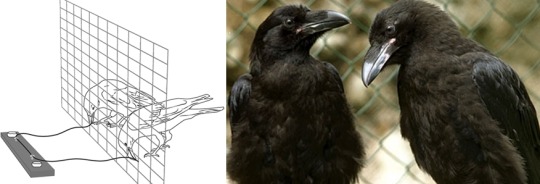
In an experiment, two ravens had to simultaneously pull the two ends of one rope to slide a platform with two pieces of cheese into reach. If only one of them pulled, the rope would slip through the loops, leaving them with no cheese. Without any training they solved the task and cooperated successfully.
However, when one of the two birds cheated and stole the reward of its companion, the victims of such cheats immediately noticed and started defecting in further trials with the same individual.
“Such a sophisticated way of keeping your partner in check has previously only been shown in humans and chimpanzees, and is a complete novelty among birds.”




 (ノ´ヮ´)ノ✧